Event Planners: Deploy Event Technology in 2026, No Major Integration
SnapPix TeamPublished 5 Oct 202644 min read

Operational AI, integrated identity systems and governance that attendees can trust will define which event technologies succeed in 2026. The headline trends, AI automation, biometric check-in and platform consolidation, only deliver value when paired with clear consent and data practices. For planners, the practical implication is simple: prioritise integration and governance over novelty, and pilot before you scale.
TL;DR:
- Pilot agentic AI tools with clear human oversight, audit logs, and established review points before scaling to ensure safe autonomous decision-making.
- Adopt biometric check-in systems only with transparent consent, decentralised identity, liveness checks, and options to opt out to protect attendee privacy.
- Focus on first-party data collection and incremental personalization, limiting data gathering to essentials and building attendee trust for future engagement.
- Use low-effort pilot tools like no-app QR guest photo uploads to measure engagement and feedback without complex integration or onboarding friction.
- Prioritize integrating and governing event tech platforms for data continuity, security, and compliance, rather than chasing novelty or multiple disconnected tools.
Here’s a quick way to see which trends apply to your role before we go deeper into each one.
Each one is worth a closer look, because the gap between “interesting” and “ready to run at scale” is wider than most planners expect.
AI adoption in events has moved past the experimental phase for most organisers, but agentic systems, the kind that act autonomously across a workflow, are a different story. Forrester’s 2026 report found that agentic AI is technically viable this year, yet most enterprises still lack the orchestration maturity and governance needed to scale autonomous agents safely. The gap sits between proof-of-concept and production, not between ambition and technology.
Separately, Event Tech Live’s research shows 45% of event organisers are actively using AI already, and 65% plan to increase their use within the next one to two years.
What’s production-ready right now: AI-driven content recommendations, session summarisation, attendee matchmaking and smart photo organisation. What needs more caution: fully autonomous agents making decisions without review, especially around payments, personal data or guest communications.
A short governance checklist before you scale any AI tool:
Pro Tip: Start AI pilots with a single, well-defined task, such as session recommendations, before asking any system to manage a multi-step workflow. Our own practical guidance on early AI pilots covers how smaller teams can test this without heavy investment.
Attendees expect relevant schedules, recommendations and follow-up content, but the organisers delivering this well are the ones collecting less data, not more. Progressive profiling, where you ask for information gradually and only when it’s useful, beats a long registration form every time. Consent sits at the start of this process, not as an afterthought buried in terms and conditions.
Personalised features worth building into your 2026 event:
A few data design rules keep this ethical and manageable. Collect only what a feature genuinely needs, resist the temptation to gather “just in case” fields. Tie personal data to identity carefully, and avoid merging registration data with biometric or behavioural data unless there’s a clear, consented purpose. Set a retention policy upfront, and communicate it. Event-Technology Portal’s analysis of event data security notes that structured and behavioural data generated across modern stacks require careful governance and vendor oversight to manage cross-border transfer rules and shifting compliance expectations.
Personalisation done this way builds trust rather than spending it, and that trust is what makes attendees comfortable sharing more next time.
Biometric systems, facial recognition, palm scanning, voice and behavioural biometrics, are moving past pilot stage into integrated identity ecosystems for events. Event-Technology Portal’s 2026 analysis describes this shift as being as much about trust and consent as it is about technology, with decentralised identity frameworks rising alongside concerns about bias and privacy.
One pilot reported a substantial reduction in queue times when identity tokens were bound to biometric gates at arrival, according to research on AI enrolment and mobile biometrics.
Common onsite uses include:
Trust architecture matters as much as the modality chosen. Clear consent flows, decentralised identity that keeps biometric templates off a central server, liveness checks to prevent spoofing, and a non-biometric fallback for anyone who opts out. Skipping any of these risks regulatory exposure and reputational damage that outweighs the convenience gained. For queue-specific fixes that don’t require biometric investment, operational approaches to event queue management are worth reviewing alongside any biometric rollout.
Not every event needs a virtual reality headset, and most don’t. The decision between full AR/VR immersion and enhanced hybrid streaming usually comes down to audience size, budget and whether the experience adds something a good livestream can’t. AR/VR earns its cost for product launches, training simulations or spatial experiences that genuinely benefit from depth. For most conferences and corporate events, a well-produced hybrid stream with interactive elements delivers more value per pound spent.
Before committing to either, run through a short production checklist:
Equitable design might mean giving remote attendees a dedicated Q&A slot, or matching them into breakout discussions alongside in-person guests. The goal is parity of experience, not just parity of access.
The strongest argument for consolidating event platforms isn’t convenience, it’s data. When registration, check-in, engagement and post-event analytics sit in separate systems, measuring the full attendee journey becomes guesswork. MPI’s analysis of emerging technologies notes that the industry’s emphasis has shifted from adding more tools to choosing purposeful tech that fits existing revenue and CRM systems.
That said, a single all-in-one platform isn’t automatically the right answer. Best-of-breed tools often perform better individually, the trade-off is integration work and the risk of data silos if that work isn’t done properly.
Integration priorities to get right regardless of which path you choose:
When evaluating a new vendor, ask directly about data portability and interoperability before asking about features. A platform that locks your attendee data in proprietary formats will cost you far more at renewal time than its sticker price suggests.
Event stacks now touch registration data, wearables, mobile apps and behavioural tracking, often across several vendors and sometimes across borders. Event-Technology Portal’s research on event data security points to global regulations like GDPR and CCPA, and their successors, as a growing source of complexity for organisers managing cross-border data flows.
A workable minimum standard for 2026:
Retention policy deserves its own line item. Decide upfront how long attendee data lives after the event, and build deletion into your contracts with every vendor touching that data.
Technology rarely fails because it doesn’t work, it fails because teams aren’t trained to run it. Event Tech Live’s survey data found training to be the top barrier to AI adoption, cited by 30% of event organisers, ahead of cost at 25%.
A practical path through this:
Good KPIs for a pilot include staff task completion time, error rate against manual processes and attendee-facing satisfaction scores. If those three trend positively over two to three events, you’re ready to scale.
Digital badges, optimised travel routing and localised micro-events replacing one large gathering all reduce an event’s footprint in measurable ways. Technology’s real contribution here is reporting: sponsors increasingly expect verified impact data, not a paragraph of good intentions in a post-event summary. Track energy use, material waste and travel emissions through the same systems you use for registration and badge data, rather than bolting on a separate sustainability tool. Be wary of vendor sustainability claims that aren’t independently measured or verified, a badge printed on recycled card means little if the shipping footprint behind it goes unreported.
Start by scoring each candidate technology on impact versus effort, and resist the pull of anything high-effort with uncertain payoff.
Each pilot should run for one full event cycle before you decide to scale, pause or drop it.
Pro Tip: Run your three pilots across different events rather than stacking them on one, so a problem in one system doesn’t muddy your read on the others.
Guest engagement technology doesn’t need to be complicated to work well. Our own no-app QR photo flow lets guests scan a code and upload photos instantly through their phone’s browser, no app, no account, no friction. AI-driven smart albums then organise those uploads automatically, grouping images without manual sorting, while photo challenges nudge guests to capture specific moments throughout an event.
Across real events, this approach has collected over 4,200 guest photos, a useful proof point for how low the barrier to participation can be when there’s nothing to download or install.
A few practical lessons from running this at scale:
To pilot something similar, measure uploads per guest, time to first upload after the QR code appears, and completion rate on any photo challenges you set. These three numbers tell you more about engagement than attendance figures alone.
Reliable connectivity has quietly become one of the most important pieces of event infrastructure. 5G networks support dense, simultaneous device use at scale, live polling, high-resolution video uploads and real-time translation feeds, without the congestion older Wi-Fi setups struggled with at large venues.
Real-time translation is the feature attendees notice most directly. Multilingual events can now offer live captioning or audio translation through an app or headset without the cost of a full interpreter booth for every language pair. This matters increasingly for international conferences where attendee lists span several language groups, and it removes a real barrier to participation for non-native speakers who might otherwise miss nuance in fast-paced sessions.
Beyond translation, these communication technologies support richer interaction generally: instant polling with visible results, synchronised multi-camera streaming for hybrid sessions, and low-latency audio for Q&A across large rooms. The common thread is that none of this requires attendees to install anything new, the improvement happens in the infrastructure layer, which is exactly why it’s easy to overlook when planning tech spend.
For planners weighing where to invest, connectivity upgrades often deliver more visible attendee benefit than a flashy standalone app, simply because every other feature depends on the network holding up under load.

Large venues create a specific technical problem: thousands of devices, sensors and cameras generating data simultaneously, all needing processing fast enough to feel instant. Sending every signal back to a distant central server introduces delay that attendees notice, a lagging live poll, a stuttering AR overlay, a check-in scan that hangs for a few seconds too long.
Edge computing processes data closer to where it’s generated, on local servers within the venue rather than in a remote data centre, cutting that round-trip time significantly. For biometric check-in gates, this is often the difference between a near-instant scan and a queue that backs up within minutes.
Practical applications at events include local processing for badge scanning and access control, on-site rendering for AR experiences that need to respond to movement without lag, and real-time crowd density monitoring that doesn’t wait on a cloud round-trip to flag a bottleneck.
The trade-off is infrastructure cost and setup complexity. Edge computing requires local hardware at the venue, which isn’t always practical for a one-day pop-up event but becomes worthwhile for recurring conferences, large trade shows or any event where check-in speed and responsiveness are mission-critical to the attendee experience.
Internet of things devices, networked sensors embedded through a venue, are increasingly handling the operational details that used to rely on staff doing manual rounds. Occupancy sensors can flag when a session room is nearing capacity before a queue forms outside. Environmental sensors adjust climate control in real time rather than on a fixed schedule, which matters considerably in venues with uneven crowd distribution across different halls.
Smart lighting and signage respond to occupancy and time of day automatically, cutting energy waste outside peak hours. Asset tracking tags help event staff locate equipment, from AV gear to registration kiosks, without the scramble that comes from misplaced inventory during a live event.
The more mature use case is safety: sensors that detect overcrowding in real time and alert staff before a situation becomes a hazard, rather than after. This kind of monitoring works quietly in the background, which is exactly the point, attendees shouldn’t notice the technology, only that the room felt comfortable and the queues moved.
Adoption barriers are mostly practical: sensor installation and calibration take time, and venues vary widely in what infrastructure they already support. Organisers running recurring events at the same venue see the strongest payoff, since the setup cost amortises across multiple bookings rather than a single one-off event.

Ticket fraud and scalping remain persistent problems for high-demand events, and blockchain-based ticketing addresses this by recording ownership on a distributed ledger that’s difficult to forge or duplicate. Each ticket becomes a unique, verifiable token rather than a PDF that can be screenshotted and resold multiple times.
The practical benefit shows up most clearly for high-value events: concerts, major conferences and anything with a resale market, where organisers want visibility into who actually holds a ticket and at what price it changed hands. Smart contracts can also enforce resale price caps automatically, something near impossible to police manually once tickets leave the original point of sale.
For lower-stakes events, the overhead of blockchain infrastructure often isn’t worth the complexity it adds. A community workshop or a small corporate gathering typically doesn’t face the fraud pressure that justifies the setup. The technology earns its place when ticket value and fraud risk are both genuinely high, not as a default for every event type.
Organisers considering this route should weigh the added friction for attendees unfamiliar with digital wallets against the fraud reduction benefit, and plan support resources accordingly for anyone who needs help claiming a token-based ticket for the first time.
AI-generated content is increasingly handling the volume work around events: social media teasers, personalised recap videos, and multilingual promotional copy generated faster than a small marketing team could produce manually. Virtual influencers, AI-driven personas with no human behind the camera, are also appearing in event promotion, particularly for younger or digitally native audiences who engage readily with this format.
The appeal is speed and consistency. A virtual presenter can deliver the same polished welcome message in multiple languages without reshoots, and AI tools can generate dozens of social content variations from a single event brief.
The caution here mirrors the agentic AI discussion earlier: content generated without human review risks tone mismatches, factual errors or messaging that doesn’t reflect an organiser’s actual values. The practical approach treats AI-generated content as a fast first draft, not a finished product, with a human editor checking tone and accuracy before anything goes live.
For most event marketing teams, the sensible starting point is narrower than full virtual influencer campaigns: AI-assisted copywriting, automated recap video generation and multilingual content drafts offer clear time savings with lower reputational risk than a fully autonomous virtual persona representing your brand.
The question behind every technology decision in this article is the same: does it pay for itself in measurable outcomes? PCMA’s trends research points to rising concern over event tech costs, pushing organisers toward outcome-driven investment rather than acquiring tools because they’re available.
A workable cost-benefit approach starts before purchase: define the specific metric a technology should move, attendee satisfaction score, check-in time, sponsor lead quality, before signing a contract, not after deployment when it’s harder to isolate what caused a change.
For AI tools specifically, compare staff hours saved against subscription and training costs over a full event cycle, not just the first event, since training time eats into early savings. For biometric or identity systems, queue time reduction and manual fallback rate are concrete, comparable numbers across events. For platform consolidation, the ROI often shows up as reduced reconciliation time across systems rather than a single flashy metric.
The organisers getting this right treat every new tool as a hypothesis to test, not a commitment to defend. A pilot that doesn’t move its target metric within one or two events is a signal to adjust or drop it, not a reason to extend the trial indefinitely hoping for different results.
Stop buying tech without checking it integrates with what you already run, stop treating consent as a formality, and stop expecting AI to solve problems your process already has. Start with small, measurable pilots instead of full rollouts, start tracking engagement outcomes rather than adoption for its own sake, and start asking vendors hard questions about security before signing anything. The technology matters less than the discipline around how you test it.
— Liam
If you want to test attendee engagement trends without a heavy integration project, a no-app QR gallery is one of the simplest places to start. We built SnapPix around removing every point of friction for guests: no app to download, no account to create, just a scan and an instant upload from whatever device someone already has in their hand.
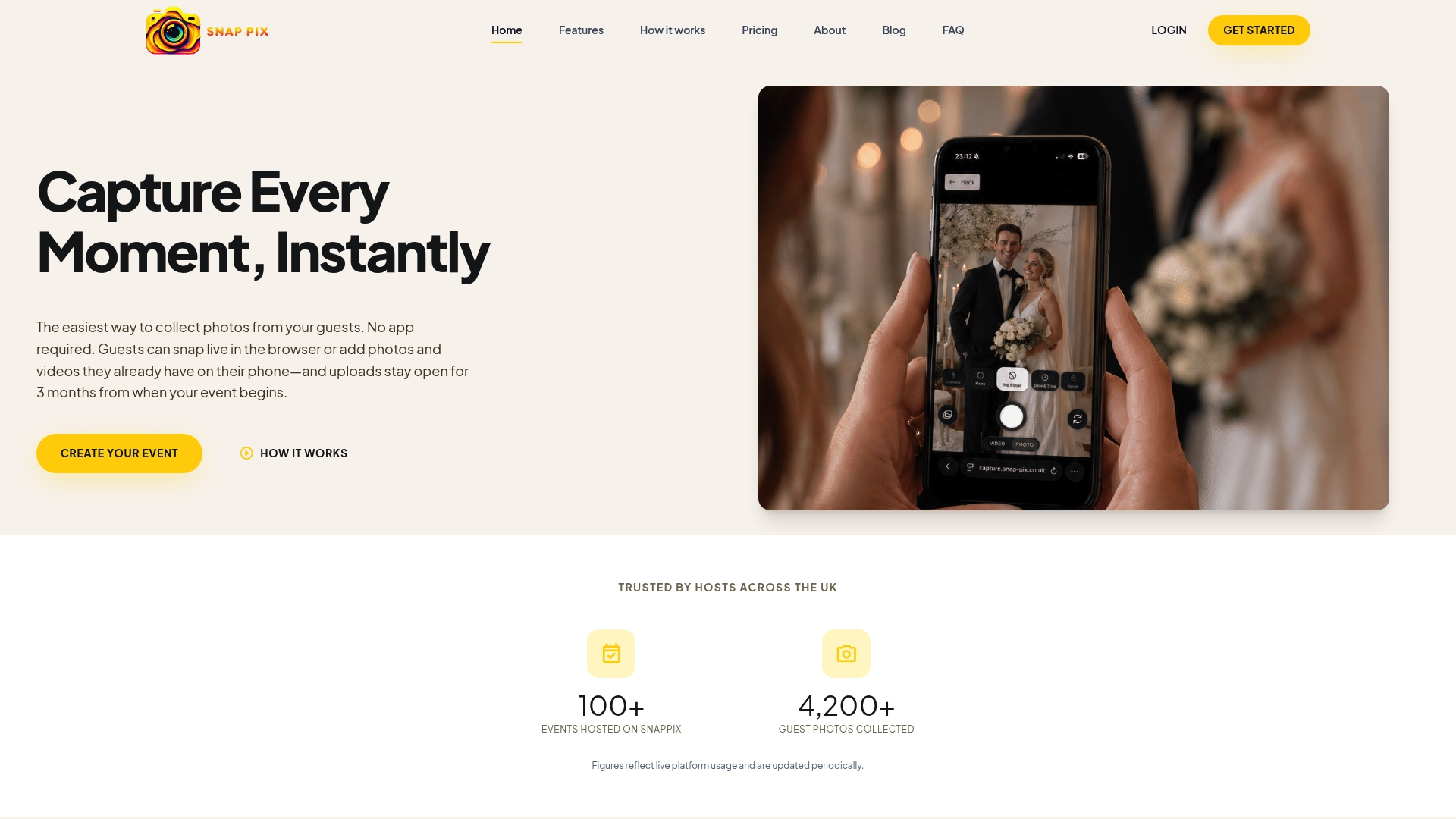
What’s included:
Full Event Access is a one-off £14.99 per event, and a Free plan is available for a lighter first test. Full feature details sit on our features page, and if you’re weighing data retention against your own governance policy, our deletion policy sets out exactly how long guest uploads remain accessible.
The leading trends are operational AI, biometric and digital identity systems, platform consolidation, and governance frameworks that make attendee data trustworthy. Forrester’s 2026 report notes that agentic AI has become technically viable, though most organisations still need stronger orchestration and governance to scale it safely.
The near-term future favours integration over novelty: tools that connect cleanly across registration, check-in and engagement data, with consent and security built in from the start. Event Tech Live’s research found that 65% of event organisers plan to increase their AI use within one to two years, which points toward steady, practical adoption rather than a sudden technology shift.
Well-designed biometric systems rely on consent flows, decentralised identity that avoids storing templates centrally, and liveness checks to prevent spoofing, alongside a non-biometric fallback for anyone who opts out. Event-Technology Portal’s analysis frames this as a trust and governance challenge as much as a technical one.
Staff training is the leading barrier, cited by 30% of event organisers, ahead of cost at 25%, according to Event Tech Live’s survey data. Role-focused training and small, measurable pilots address this more effectively than a full rollout attempted all at once.
A no-app QR photo flow is a low-risk way to test engagement without onboarding friction, since guests need nothing more than a phone browser to participate. Similar flows have collected thousands of guest photos across real events, giving a useful reference point for how readily guests engage when there’s nothing to install.

Event hosts' practical guide to posed and candid photos: perception research, hands on shooting tips, and no app guest uploads to boost candid coverage.

Which routes keep EXIF or strip GPS? Quick checks to view or remove metadata, plus a three month workflow to collect guest photos.

Quickly restore guests' browser camera access with a two minute checklist, host-ready fixes, and a QR upload fallback so photos keep flowing at your event.