8–10 Weeks to Close Your List: Wedding Guest List Rules for Couples
SnapPix TeamPublished 4 Sept 202630 min read

Set your cap first, then prioritise your inner circle. Apply consistent plus-one and children rules across every family and friend group, and give each set of parents a fixed allocation rather than an open invitation to add names. A guest list built this way stays defensible when someone questions it, and it keeps you within budget and venue capacity without a single awkward renegotiation later on.
TL;DR:
- Setting a firm maximum guest count before drafting the list helps ensure budget and venue capacity are not exceeded.
- Applying consistent plus-one and children policies across all guests prevents misunderstandings and hurt feelings.
- Using objective filters like recent communication, reciprocity, and meal compatibility streamlines guest list trimming.
- Sending B-list invitations only after confirming declines from the main invitees maintains proper timing and reduces stress.
- Managing family and partner relationships with written allocations and clear boundaries avoids conflicts and maintains control.
You don’t need a philosophy for this, just a checklist you can apply the moment names start piling up. Work through these in order and most disputes solve themselves before they start.
Most couples try to build one list in one sitting and burn out halfway through. A tiered approach avoids that. Sort every potential guest into three groups: must invite, would like to invite, and B-list. When you need to cut, you cut from the bottom tier first, never by picking through your must-invites again.
Splitting slots between the couple and both sets of parents needs a template, not a vibe. Three common ones work:
The practical sequence matters as much as the split itself. Each partner drafts a private must-have list first, without editing each other in real time. Then you merge the two, remove duplicates, and only after that do you hand parents their fixed allocation. Expert guidance is consistent on one point: lock the total headcount before you order save-the-dates, because every name added after that point displaces one you’ve already promised a seat.
Pro Tip: Merge your lists in a shared spreadsheet, not a group chat. A chat thread loses names; a spreadsheet keeps a single, current version everyone can check.
Pick one plus-one policy and one children policy before you send a single invite, then apply both without exceptions. Consistency is what prevents the “why does she get a plus-one and I don’t” conversation.
For children, the three usual options are adults-only, immediate family children only, or everyone’s kids welcome. Whichever you choose, put it in writing rather than leaving guests to guess. A wedding website line such as “We’re so excited to celebrate with adults only” or an invitation addressed to named individuals only, with no “and family”, does the job without needing a follow-up phone call.
Cutting names by gut feeling is where guest lists get messy. Objective filters remove the guesswork:
B-list etiquette runs on timing, not labels. Send your A-list invitations first, set an RSVP deadline that gives you breathing room, then send B-list invitations as soon as declines come in, ideally 8 to 10 weeks before the wedding. Send a full invitation, not a rushed note. Nobody needs to know they were a second wave. Chase non-responders by phone once you’re within two to three weeks of your RSVP cutoff; a text is easy to ignore, a call rarely is.
Give parents numbers, not blank invitations. “You have 25 seats to fill” is a boundary a parent can work within; “invite whoever you like” is an open door that gets pushed past every time.
Pro Tip: If a parent pushes for “just one more,” ask what should come off the list to make room. The conversation usually ends there.
A guest list is only as reliable as the tracking behind it. At minimum, track household grouping, address, RSVP status, plus-one entitlement, meal choice, dietary restrictions, and a working contact number. A shared spreadsheet with these columns, kept as one live document, usually outperforms a paid tool used inconsistently.
Per-guest cost is rarely just the plated meal; bar, rentals, cake, and venue per-person fees all add up, so build your number from all of them rather than the catering quote alone. Once you have a venue capacity figure, subtract roughly 10% to leave comfortable room for tables, dancing space, and staff movement.
| Milestone | Local wedding | Destination wedding |
|---|---|---|
| Save-the-dates | several months out | 8 to 12 months out |
| Invitations sent | 8 weeks out | 12 weeks out |
| RSVP deadline | 4 to 5 weeks before | several weeks before |
| B-list invites (if needed) | 8 to 10 weeks before | N/A, send with A-list |
A single tracked guest list also makes it far easier to catch double counts or missing plus-ones before invitations go to print.
Start with a shared spreadsheet, since it’s free and forces everyone onto one version of the truth and can integrate smoothly with tools like one family app that can handle birthdays, dates, and gift lists to keep reminders coordinated. Add columns for household, RSVP status, plus-one entitlement, meal choice, and dietary needs, and treat it as the single source everyone edits.
Extended plus-ones, where a guest’s plus-one wants to bring someone else, are one of the few situations where “no” needs almost no explanation. A plus-one is an extension of your relationship with the primary guest, not a standing invitation for that guest’s entire social circle. If you allow it once, you’ve effectively opened the policy to everyone, and your headcount cap disappears with it.
The clearest way to prevent this is naming invitees explicitly on the invitation itself, rather than writing “and guest.” An invitation addressed to “Sarah Bennett and Tom Grady” leaves no ambiguity; one addressed to “Sarah Bennett plus guest” invites the question of who that guest might be, and occasionally an assumption that it’s negotiable.
Where this gets genuinely difficult is with wedding party members who have new partners you haven’t met, or long-distance friends travelling alone to your wedding. In both cases, decide the policy once, in private, rather than letting it become a per-request negotiation. If you’re extending plus-ones to your wedding party as a blanket rule, that’s a defensible, consistent line. If you’re doing it because one person asked persuasively, you’ve created a precedent you’ll have to honour for everyone else who asks next, and that’s how a guest list creeps ten or fifteen names past its cap. Write the rule down, apply it evenly, and if someone pushes back, the answer is simply that the policy is the same for every guest on the list.
Blended families multiply the number of people who reasonably feel entitled to an opinion, which is exactly why a fixed allocation matters more here than anywhere else. Step-parents, half-siblings, and a parent’s new partner all occupy relationship categories that traditional etiquette guides barely address, so the couple has to decide the hierarchy themselves rather than relying on convention.
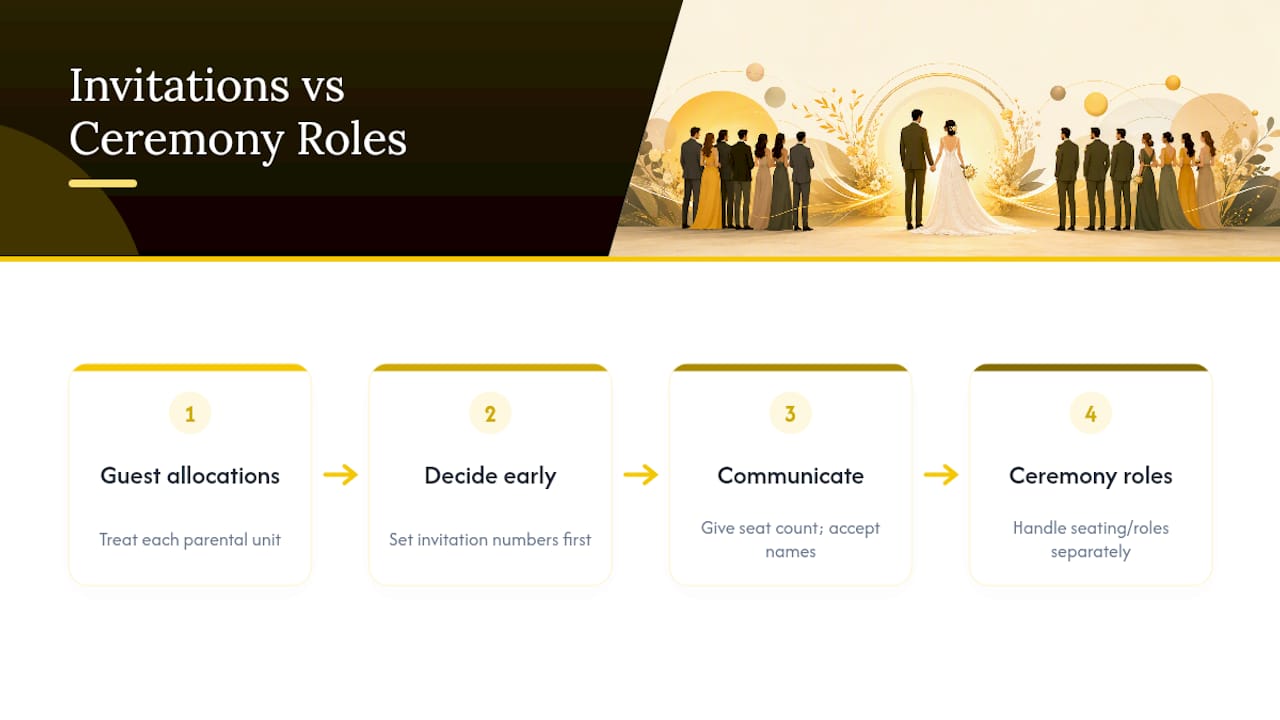
A workable approach treats each parental unit, biological and step, as its own allocation source rather than lumping “Dad’s side” and “Mum’s side” into two blocks. If your father remarried and his wife has been a genuine part of your life for a decade, she likely belongs in the same tier as your biological parents, regardless of what a traditional seating chart template suggests. Conversely, a step-parent you’ve met twice sits much further down the list, and that’s a fair, defensible position provided you apply the same logic consistently to every blended relationship in your family, not just the ones that are convenient to exclude.
Where blended families cause real friction is at the ceremony itself, not the invitation stage: who walks whom down the aisle, who sits in the front row, who’s acknowledged in a speech. Settle guest list questions separately from those seating and role questions, and settle them early, because a parent who feels sidelined on the invitation list is far more likely to raise concerns about seating later. Communicating the guest list decision doesn’t need to double as a family therapy session. State the number of seats available to that side of the family, let them propose names within that number, and keep the deeper relationship questions in a separate, calmer conversation.
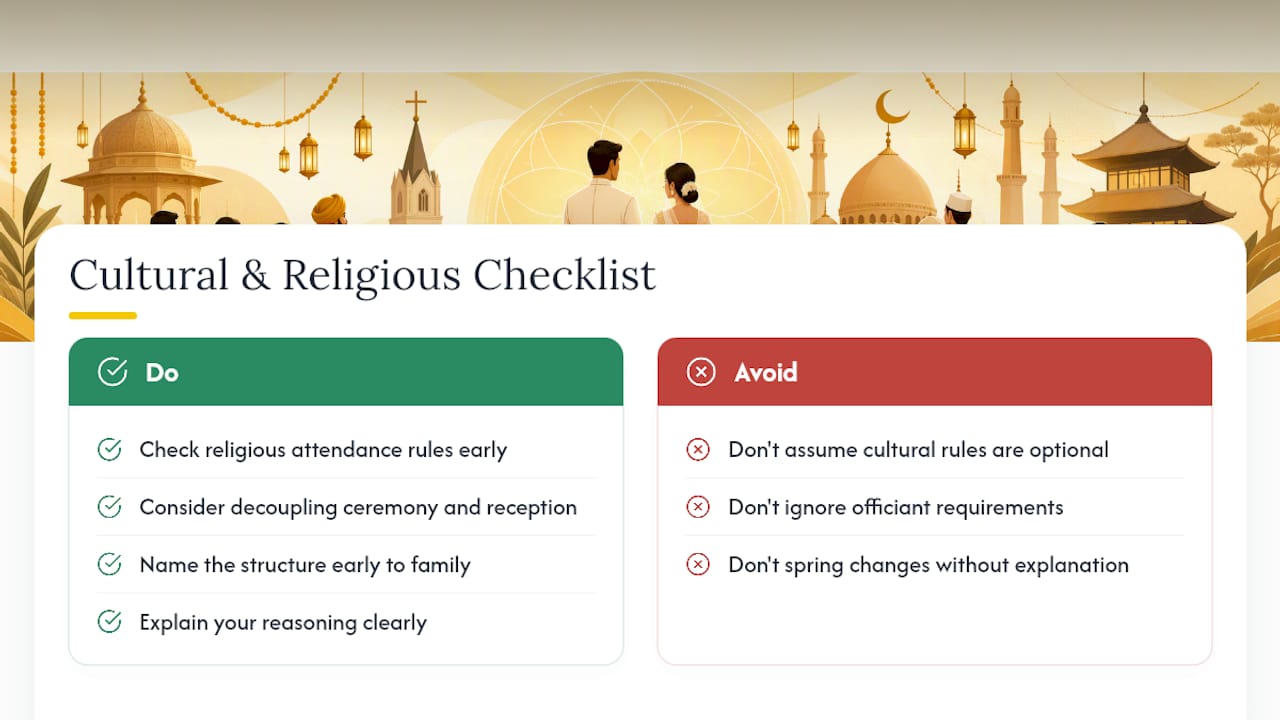
Some traditions carry guest list expectations that override the couple’s-preference framework entirely. In many South Asian weddings, for example, guest counts in the hundreds are standard because extended family and community networks are expected to attend as a matter of course, not courtesy. A couple following that tradition working from a Western “close friends and immediate family only” template will find themselves fighting their own culture’s expectations rather than clarifying them.
Religious ceremonies can also impose their own attendance rules separate from the reception guest list. Some churches, synagogues, and temples require or strongly expect certain family members, godparents, or religious sponsors to be present at the ceremony itself, regardless of whether the couple would otherwise invite them to the reception. It’s worth checking with your officiant or religious leader early, since these requirements sometimes conflict with a couple’s instinct to keep the ceremony small and the reception larger, or vice versa.
Where cultural and personal preferences genuinely clash, a useful strategy is decoupling the events: a smaller, personally chosen ceremony followed by a larger reception that honours family and community expectations, or the reverse. This isn’t a universal fix, and it adds cost and logistics most couples would rather avoid, but it does let you keep both your rules and your family’s expectations intact rather than sacrificing one for the other. Whatever structure you choose, name it early and explain the reasoning to family, since an unexplained departure from tradition invites far more pushback than a clearly reasoned one.
The guest list conversation goes wrong most often not because the rule is unreasonable, but because it’s delivered defensively or too late. Say the rule plainly, early, and without over-explaining: “We’ve set our numbers based on our budget and venue, and we’re keeping to them for everyone.” That sentence, said once and calmly, does more work than a long justification that invites debate.
Give people the reason, not a running commentary. “We’re at capacity” is a complete answer. Adding six extra sentences about the venue contract, the caterer’s per-head pricing, and how hard the decision was tends to sound like an opening for negotiation rather than a closed door. State the fact, then stop talking.
Deliver difficult news in person or by phone rather than text where the relationship warrants it, particularly with close family or old friends who might otherwise be invited. A text saying “we can’t invite you” reads as dismissive even when that’s not the intent; five minutes of conversation, even an awkward one, tends to land better and preserves the relationship afterwards.
Finally, don’t promise flexibility you don’t intend to give. If a parent asks whether the number might change later and you already know it won’t, say so now. A false “maybe” someone builds hope around and later has revoked causes far more damage than a firm “no” delivered kindly the first time.
Rules exist so you don’t have to relitigate the same argument with five different family members. Once you’ve set your cap, your plus-one policy, and your children policy, you have permission to be decisive, and decisive is kinder than dragging every decision out for weeks. Draft your first list today, lock the number, and let the rules do the difficult conversations for you.
— Liam
Your guest list rules decide who’s in the room. What happens to the photos everyone takes once they’re there is a separate problem, and it’s usually the one couples solve worse, chasing photos from thirty different phones for weeks after the wedding. SnapPix gives every guest on your finished list a QR code they can scan to upload straight from their camera roll or capture live, with no app to download and no account to create.
The upload window stays open for three months after the day, which covers the inevitable stragglers who forget to send photos until they’ve unpacked from the honeymoon. AI-driven smart albums sort the flood of uploads automatically, and photo challenges nudge guests towards the shots you’d never think to ask for. It slots in neatly once your guest list and RSVPs are locked, since it’s built for exactly the headcount your rules just settled. Take a look at the full feature list and set up your gallery before invitations go out, so the QR code is ready the moment guests arrive.
For deeper guidance beyond this guide, The Knot’s guest list walkthrough covers allocation basics in more depth, while Brides’ rules roundup is the sharpest source on objective cutting filters. Green Wedding Shoes offers a practical, budget-first framework worth reading before you draft your first list.

Secure sponsor access to event photos with a host controlled workflow. Use time limited QR links, view only tokens, instant revocation, and access logs.

A practical host first workflow: collect no app QR uploads, keep moderation and professional curation, set retention and backup plans so you stay in control.

Event hosts' practical guide to posed and candid photos: perception research, hands on shooting tips, and no app guest uploads to boost candid coverage.